
Understanding percentage increase is more than just a math problem; it’s a fundamental skill with broad applications across finance, retail, science, and technology. From tracking investment growth to analyzing population trends, the ability to accurately calculate and interpret these changes is crucial for informed decision-making. This guide dives deep into the core concepts, practical applications, and advanced techniques of percentage increase, equipping you with the knowledge to navigate the world of numbers with confidence.
This comprehensive exploration will demystify the process, starting with the basic formula and progressing through real-world examples. We’ll examine the formula’s components, offer step-by-step instructions, and highlight common pitfalls to avoid. Furthermore, we’ll delve into the nuances of consecutive increases, compare and contrast percentage increase with its counterpart, percentage decrease, and explore various tools and techniques to streamline calculations. Get ready to transform your understanding of percentages from a theoretical concept to a practical tool for everyday use.
Understanding the Core Concept of Percentage Increase is Fundamental for Accurate Calculations
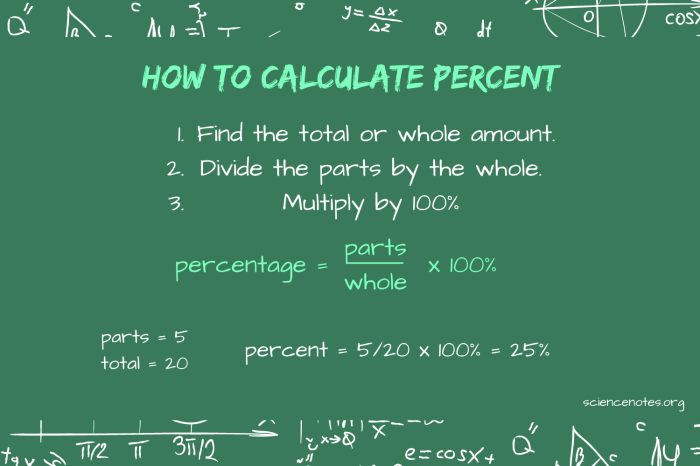
Understanding percentage increase is a critical skill in finance, economics, and everyday life. It allows us to quantify the relative change between two values, providing a clear and concise way to understand growth, inflation, or any other form of increment. Mastering this concept is not just about crunching numbers; it’s about interpreting data and making informed decisions. This foundational understanding unlocks the ability to analyze trends, evaluate investments, and assess the impact of changes in various contexts.
Defining Percentage Increase
Percentage increase quantifies the growth of a value over time, relative to its initial value. It expresses this change as a percentage, making it easy to compare changes of different magnitudes. The core formula for calculating percentage increase is straightforward:
Percentage Increase = [(New Value – Original Value) / Original Value] * 100
This formula highlights the importance of the original value as the baseline. The difference between the new and original values is divided by the original value to determine the proportion of change. Multiplying by 100 converts this proportion into a percentage. A positive result indicates an increase, while a negative result indicates a decrease (which is often referred to as a percentage decrease). For instance, if a stock price rises from $100 to $110, the percentage increase is [(110 – 100) / 100] * 100 = 10%. This means the stock price has increased by 10% relative to its initial value. The use of percentage increase allows for a standardized way to compare different changes, regardless of the initial size of the values involved. This is crucial for comparing the performance of different investments, analyzing economic growth rates, or evaluating price changes of different products. It provides a common language for understanding and communicating change effectively.
Real-World Scenario: The Impact on Retail Sales
Consider a retail company, “Global Gadgets,” that sells electronics. In the first quarter of 2023, the company’s total sales were $1,000,000. Through effective marketing campaigns and product promotions, their sales increased to $1,200,000 in the second quarter. To calculate the percentage increase in sales, we apply the formula: [(1,200,000 – 1,000,000) / 1,000,000] * 100 = 20%. This 20% increase is a significant indicator of the company’s growth and success during that period.
The impact of this percentage increase extends beyond just a numerical value. Firstly, it provides a benchmark for evaluating the effectiveness of the marketing strategies and promotional activities. Secondly, it influences decision-making for future investments. If the company continues to see similar or higher percentage increases in subsequent quarters, they might decide to allocate more resources to marketing, product development, and expansion. Thirdly, it influences investor perception. A consistent growth rate, demonstrated by increasing percentage sales figures, can boost investor confidence, potentially leading to higher stock prices and easier access to capital. For example, if Global Gadgets’ stock price was initially $50 per share, and a 20% increase in sales led to increased profitability, the stock price might rise to $60 per share, reflecting the improved financial performance. Finally, percentage increase helps in comparing the performance of Global Gadgets with its competitors. If competitors only saw a 10% increase in sales during the same period, Global Gadgets’ 20% increase highlights their superior market position and growth trajectory. This comparison helps the company understand its competitive advantage and identify areas for further improvement. Without the ability to accurately calculate and interpret percentage increases, these vital insights would be lost, hindering strategic planning and decision-making.
Common Misconceptions About Percentage Increase
It is essential to address common misconceptions about percentage increase to avoid errors in calculations and misinterpretations of data. Here are some of the frequent misunderstandings:
-
Misconception: Confusing percentage increase with the absolute difference.
Explanation: People often mistakenly equate the absolute difference between two values with the percentage increase. For example, if a price increases by $10, some might incorrectly assume that is the percentage increase, ignoring the original price’s impact. -
Misconception: Incorrectly using the new value as the denominator.
Explanation: The percentage increase formula requires dividing the difference by the *original* value. A common mistake is using the new value as the denominator, leading to an inaccurate result. This would significantly underestimate the percentage change. -
Misconception: Assuming a percentage increase is always a positive value.
Explanation: While percentage increase often refers to a growth, it can also be negative, representing a decrease. Failing to recognize this leads to misinterpreting data where a value has fallen. For instance, if a company’s profits decrease from $500,000 to $400,000, the percentage change is negative, indicating a decline. -
Misconception: Adding or subtracting percentages directly without considering the base values.
Explanation: This is common when dealing with multiple percentage changes. For example, if a price increases by 10% and then decreases by 10%, it is incorrect to assume the net change is zero. The second percentage change is based on a different value, resulting in a net decrease. -
Misconception: Not understanding the context of the percentage increase.
Explanation: Percentage increase is a relative measure. Its significance depends on the context. A 10% increase in a small company’s revenue might be less significant than a 5% increase in a large multinational corporation’s revenue.
The Basic Formula and Its Application Forms the Cornerstone of Calculation
Understanding how to calculate percentage increase is a fundamental skill in finance, economics, and everyday life. The ability to accurately determine the proportional change between two values is crucial for informed decision-making, whether analyzing investment returns, understanding inflation rates, or simply comparing the prices of goods. This section delves into the core formula, providing a clear and concise framework for understanding and applying this essential mathematical concept.
The Basic Formula for Percentage Increase
The basic formula for calculating percentage increase is straightforward but requires a clear understanding of its components. It allows us to quantify the relative change between an initial value and a subsequent value. This formula is universally applicable, allowing for consistent and accurate results across various scenarios.
The formula is as follows:
Percentage Increase = ((New Value – Original Value) / Original Value) * 100
Let’s break down each component:
* Original Value: This is the starting point, the initial amount or quantity before the change occurs. It serves as the baseline against which the increase is measured. Identifying the original value correctly is paramount; any misidentification will lead to inaccurate results. For example, if we are analyzing the price increase of a stock, the original value would be the stock price at the beginning of the period under consideration.
* New Value: This is the amount or quantity after the change has taken place. It represents the final value after the increase. In the stock price example, the new value would be the stock price at the end of the period. This value is compared to the original value to determine the extent of the change.
* New Value – Original Value: This calculates the absolute difference between the new and original values. This difference represents the raw increase, without considering the original size of the value. A positive result indicates an increase, while a negative result would indicate a decrease.
* (New Value – Original Value) / Original Value: This step normalizes the absolute difference by dividing it by the original value. This creates a ratio that expresses the increase relative to the starting point. This ratio is crucial because it allows for meaningful comparisons, regardless of the absolute sizes of the original and new values.
* ((New Value – Original Value) / Original Value) * 100: Multiplying the ratio by 100 converts it into a percentage, making it easier to understand and compare. The percentage represents the proportional change, expressed as a fraction of 100. The resulting percentage indicates the magnitude of the increase.
Step-by-Step Procedure for Calculating Percentage Increase
Applying the percentage increase formula involves a structured approach. Following a clear, step-by-step procedure ensures accuracy and consistency. The process can be applied to a wide range of problems, from simple price changes to more complex financial analyses.
Here’s a step-by-step guide:
* Identify the Original Value: Begin by carefully identifying the initial value or the starting point. This is the value before any change occurs. It’s crucial to correctly identify this value to avoid errors in the calculation.
* Identify the New Value: Next, identify the value after the change has taken place. This is the final value. Again, accurate identification is critical.
* Calculate the Difference: Subtract the original value from the new value. This gives you the absolute increase or decrease. If the result is positive, it represents an increase; if negative, a decrease.
* Divide the Difference by the Original Value: Divide the difference (calculated in the previous step) by the original value. This normalizes the difference relative to the starting point. This results in a decimal representing the proportional change.
* Multiply by 100: Multiply the result of the previous step by 100. This converts the decimal into a percentage, representing the percentage increase or decrease.
* State the Answer: Clearly state the percentage increase or decrease, ensuring to include the percentage symbol (%).
Example:
Suppose the price of a coffee increased from $2.00 to $2.50. Let’s calculate the percentage increase:
* Original Value: $2.00
* New Value: $2.50
* Difference: $2.50 – $2.00 = $0.50
* Divide by Original Value: $0.50 / $2.00 = 0.25
* Multiply by 100: 0.25 * 100 = 25%
* Answer: The price of coffee increased by 25%.
Importance of Correctly Identifying Original and New Values
Accurate identification of the original and new values is the most critical step in calculating percentage increase. Misidentifying these values will lead to incorrect results, rendering the entire calculation meaningless. The consequences of such errors can be significant, especially in financial contexts where even small inaccuracies can have large effects.
Consider these examples illustrating the impact of misidentification:
* Scenario 1: Investment Returns: Suppose an investment increased in value from $1,000 to $1,200. The correct calculation would be ((1200-1000)/1000)*100 = 20% increase. If we mistakenly used $1,200 as the original value, and $1,000 as the new value, we’d calculate a negative percentage change: ((1000-1200)/1200)*100 = -16.67%, implying a loss, which is incorrect. This misidentification would drastically misrepresent the investment’s performance.
* Scenario 2: Inflation Analysis: Imagine the price of a basket of goods increased from $100 to $110. The correct percentage increase is ((110-100)/100)*100 = 10%. If we incorrectly reversed the values, we would calculate a negative percentage, falsely suggesting a price decrease, which would misinform economic policy decisions.
* Scenario 3: Sales Performance: A company’s sales increased from $500,000 to $600,000. The correct percentage increase is ((600000-500000)/500000)*100 = 20%. Misidentifying the values would lead to incorrect assessments of sales growth, potentially affecting strategic decisions regarding marketing and resource allocation. If we reversed the values, we’d get a negative percentage change, implying a sales decrease, which would be inaccurate and misleading.
These examples highlight the need for careful attention to detail when identifying the original and new values. Always double-check the context and ensure that the values are correctly assigned before performing the calculation. The accuracy of the final result depends entirely on this initial step.
Practical Examples Across Various Domains Illustrate the Versatility of Percentage Increase
Percentage increase is a fundamental concept, extending its influence across diverse fields, from finance and retail to science and technology. Its ability to quantify change makes it an invaluable tool for analyzing trends, making informed decisions, and understanding the magnitude of growth or decline. This section explores how percentage increase manifests in these different domains, offering concrete examples and demonstrating its practical applications.
Finance: Stock Market Gains, Interest Rate Increases, and Inflation
The financial world is driven by numbers, and percentage increase is a critical metric used across various facets, from evaluating investment performance to understanding the impact of economic changes. It provides a standardized way to compare different financial instruments and assess the effects of economic policies.
| Scenario | Initial Value | Final Value | Percentage Increase |
|---|---|---|---|
| Stock Market Gain (Tech Company) | $100 per share | $125 per share | 25% |
| Interest Rate Increase (Savings Account) | 2% per annum | 2.5% per annum | 25% |
| Inflation (Consumer Price Index) | 110 (Base Year) | 115 | 4.55% |
| Bond Yield Increase | 3% | 3.3% | 10% |
Let’s delve deeper into these examples. In the stock market, a tech company’s stock price rises from $100 to $125 per share. The percentage increase is calculated as:
((Final Value – Initial Value) / Initial Value) * 100 = (($125 – $100) / $100) * 100 = 25%
. This 25% increase indicates the positive performance of the stock, offering a clear measure of investment return. Investors and analysts use this to assess the stock’s performance relative to benchmarks or other investments.
Next, consider a savings account where the interest rate increases from 2% to 2.5% per annum. The calculation is:
((2.5% – 2%) / 2%) * 100 = 25%
. This percentage increase reflects the improved return on savings, making the account more attractive to depositors. While seemingly small, the cumulative effect of even a slight increase can be significant over time, especially with compound interest. This impacts the financial planning of individuals, affecting their saving strategies and financial goals.
Inflation, measured by the Consumer Price Index (CPI), is another crucial application. If the CPI rises from a base year value of 110 to 115, the percentage increase is:
((115 – 110) / 110) * 100 = 4.55% (approximately)
. This indicates a 4.55% increase in the general price level of goods and services. This figure is crucial for understanding the erosion of purchasing power and for making informed decisions about spending, saving, and investment strategies. Central banks closely monitor inflation rates to adjust monetary policy, such as interest rates, to maintain price stability.
Finally, a bond yield increase, such as a rise from 3% to 3.3%, can significantly influence investment decisions. The percentage increase is:
((3.3% – 3%) / 3%) * 100 = 10%
. This increase in yield makes the bond more attractive to investors, potentially driving up its price and influencing the broader bond market. This highlights how even small percentage changes can have substantial impacts on financial markets and investment strategies. These examples demonstrate the diverse applications of percentage increase in finance, providing a common language for evaluating performance, assessing risk, and understanding economic trends.
Retail: Sales Promotions and Price Markups
The retail sector heavily relies on percentage increase calculations for sales strategies, pricing decisions, and profit margin analysis. Understanding percentage increases enables retailers to assess the effectiveness of promotions, determine competitive pricing, and optimize profitability. This section explores how percentage increase is applied in retail scenarios, providing specific examples.
Let’s look at some examples:
* Sales Promotion: A retail store offers a “20% off” sale on all merchandise. This means that the price of each item is reduced by 20% from its original price. If an item originally costs $50, the discount is
($50 * 0.20) = $10
, and the sale price is
$50 – $10 = $40
. This illustrates how percentage decrease is applied to calculate discounts. Retailers use these promotions to attract customers, clear inventory, and boost sales volume.
* Price Markup: A retailer purchases an item for $20 and marks it up by 50% to determine the selling price. The markup amount is
($20 * 0.50) = $10
, and the selling price is
$20 + $10 = $30
. The percentage markup is crucial for retailers to cover costs (such as rent, salaries, and utilities) and generate profit. The markup percentage directly affects the profit margin, which is the percentage of revenue that remains after deducting the cost of goods sold.
* Profit Margin Calculation: A product is sold for $100, and the cost of goods sold is $60. The gross profit is
$100 – $60 = $40
. The profit margin is calculated as:
($40 / $100) * 100 = 40%
. This 40% profit margin represents the profitability of selling that specific product. Retailers analyze profit margins across various products to optimize their product mix and pricing strategies.
* Calculating the Impact of a Price Increase: A product’s price is increased from $25 to $30. The percentage increase is:
(($30 – $25) / $25) * 100 = 20%
. Understanding the impact of a price increase on sales volume and profitability is essential for retailers to make informed pricing decisions.
Retailers utilize these calculations to assess the effectiveness of promotions, determine competitive pricing, and optimize profitability. By understanding and applying percentage increase, retailers can make informed decisions about pricing, promotions, and product selection, contributing to their overall success.
Science and Technology: Population Growth and Data Analysis
Percentage increase is a powerful tool in science and technology, facilitating the analysis of change across various phenomena, from population dynamics to the performance of technological advancements. This section highlights the applications of percentage increase in these fields, offering real-world examples.
Here are some specific examples:
* Population Growth: A city’s population increases from 1 million to 1.1 million over a decade. The percentage increase is calculated as:
((1.1 million – 1 million) / 1 million) * 100 = 10%
. This 10% growth rate indicates a significant population increase, influencing urban planning, resource allocation, and infrastructure development. Population growth rates are crucial for demographers and urban planners to understand trends and project future needs.
* Data Analysis in Machine Learning: A machine-learning model’s accuracy increases from 80% to 85% after training with a new dataset. The percentage increase is:
((85% – 80%) / 80%) * 100 = 6.25%
. This indicates a 6.25% improvement in the model’s performance, demonstrating the effectiveness of the new dataset. Data scientists use percentage increase to evaluate the impact of different algorithms, data sets, and model parameters on model accuracy and efficiency.
* Technological Advancement: The processing speed of a new computer chip is 2 GHz, and the previous model’s processing speed was 1.5 GHz. The percentage increase is:
((2 GHz – 1.5 GHz) / 1.5 GHz) * 100 = 33.33% (approximately)
. This 33.33% increase in processing speed reflects a significant technological advancement, leading to improved performance and efficiency. This metric is crucial for engineers and developers to evaluate and compare the performance of different technologies.
* Scientific Research: In a medical study, the effectiveness of a new drug increases the survival rate of patients from 70% to 75%. The percentage increase is:
((75% – 70%) / 70%) * 100 = 7.14% (approximately)
. While the increase might seem modest, it represents a substantial improvement in patient outcomes and the efficacy of the treatment. This highlights the importance of percentage increase in interpreting scientific data and drawing meaningful conclusions. This percentage increase can also be used to show the effectiveness of a vaccine.
These examples illustrate the broad applicability of percentage increase in science and technology. Whether it’s analyzing population trends, evaluating the performance of machine-learning models, or assessing the impact of technological advancements, percentage increase provides a valuable tool for understanding and quantifying change. The ability to express changes in a standardized and easily interpretable format makes percentage increase an indispensable tool for researchers, scientists, and engineers across various disciplines.
Advanced Applications and Considerations Expand the Horizon of Percentage Increase

Percentage increase, while seemingly straightforward, reveals its true depth when applied in complex scenarios. Understanding its advanced applications and potential pitfalls is crucial for accurate financial analysis, informed decision-making, and a comprehensive grasp of data interpretation. This section delves into nuanced aspects, equipping you with the knowledge to navigate these intricacies with confidence.
Consecutive Percentage Increases
Consecutive percentage increases represent a scenario where an initial value undergoes multiple percentage increases, one after the other. Unlike a single percentage increase applied directly to the initial value, consecutive increases compound, meaning each increase is calculated on the result of the previous increase. This compounding effect can lead to significantly different outcomes, especially over longer periods or with higher percentage increases.
To illustrate, consider an investment of $1,000. In the first year, it increases by 10%. The value at the end of the first year is $1,000 + ($1,000 * 0.10) = $1,100. In the second year, the investment increases by another 10%. However, this 10% increase is calculated on $1,100, not the original $1,000. Therefore, the increase is $1,100 * 0.10 = $110, and the value at the end of the second year is $1,100 + $110 = $1,210. This is different from a single 20% increase on the original $1,000, which would result in $1,200.
The step-by-step method to calculate consecutive percentage increases involves:
- Calculate the first increase: Multiply the initial value by the first percentage increase (expressed as a decimal). Add this result to the initial value.
- Calculate the second increase: Multiply the result from step 1 by the second percentage increase (expressed as a decimal). Add this result to the value obtained in step 1.
- Repeat for subsequent increases: Continue this process for each additional percentage increase, using the result of the previous calculation as the new base value.
The formula for consecutive percentage increases can be expressed as:
Final Value = Initial Value * (1 + Percentage Increase 1) * (1 + Percentage Increase 2) * … * (1 + Percentage Increase n)
This formula underscores the multiplicative nature of consecutive increases. Consider a business that experiences a 5% increase in sales in the first quarter, a 7% increase in the second quarter, and a 3% increase in the third quarter. The final sales figure is calculated by multiplying the initial sales figure by 1.05, then by 1.07, and finally by 1.03. The result will be different from a single percentage increase calculated by averaging the three percentages. This demonstrates the importance of understanding and applying the concept of consecutive percentage increases correctly in various financial and economic contexts. The impact of compounding is amplified over longer time horizons. For instance, in real estate, the value of a property can increase due to market appreciation. If a property appreciates by 5% annually for five consecutive years, the final value will be significantly higher than if it had appreciated by an average of 5% over the same period. This principle also applies to compound interest in financial investments, highlighting the power of consistent growth.
Tools and Techniques Streamline the Calculation Process
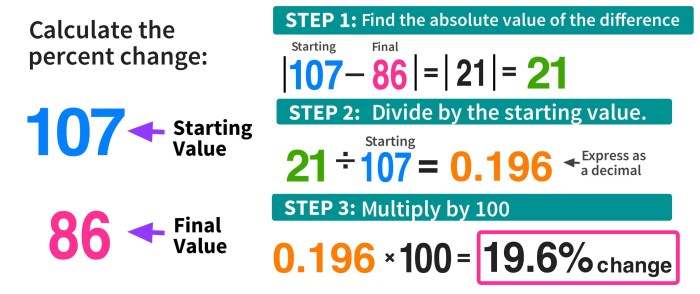
Calculating percentage increase can be simplified through various tools and techniques, moving beyond manual computation. These resources offer efficiency and accuracy, especially when dealing with large datasets or complex scenarios. This section explores different methods, from basic calculators to advanced spreadsheet applications, providing insights into their functionalities, advantages, and limitations.
Different Tools and Methods Available for Calculating Percentage Increase
Several tools and methods are available for calculating percentage increase, each offering different levels of complexity and ease of use. Understanding the strengths and weaknesses of each tool allows users to select the most appropriate method for their specific needs.
- Calculators: Basic calculators provide a simple and direct approach to percentage increase calculations. These are readily available in physical form, as software on computers, or as apps on smartphones.
- Pros: They are user-friendly, require no special skills, and are ideal for quick calculations. They are portable and accessible in almost any situation.
- Cons: They are limited to single calculations and lack the ability to handle large datasets or automate repetitive tasks. They also do not provide a history of calculations, making it difficult to review previous results.
- Functionality: Typically, users input the original value, the new value, and then calculate the percentage increase using the formula:
((New Value – Original Value) / Original Value) * 100
The calculator then displays the result directly.
- Spreadsheets: Spreadsheet programs like Microsoft Excel and Google Sheets offer powerful tools for calculating percentage increase, along with the ability to manage and analyze data.
- Pros: Spreadsheets allow for easy calculation of multiple percentage increases, the use of formulas, and the ability to visualize data through charts and graphs. They are highly flexible and can be customized to suit specific needs.
- Cons: They require some familiarity with spreadsheet software and formula syntax. They can also become complex for users unfamiliar with advanced features.
- Functionality: Users can enter data into cells, use formulas to calculate percentage increases, and apply formatting to present the results clearly. They can also create dynamic reports that update automatically when the source data changes.
- Online Tools: Numerous online percentage increase calculators are available, offering a convenient alternative to manual calculations or spreadsheet programs.
- Pros: They are easy to use, often require no registration, and provide instant results. They are accessible from any device with an internet connection. Many of these tools are free to use.
- Cons: The accuracy and reliability of online tools can vary. They may not offer advanced features or the ability to save data. Users should always verify the results, especially when using unfamiliar websites.
- Functionality: Users typically input the original value and the new value into designated fields, and the tool calculates and displays the percentage increase. Some tools also provide additional information, such as the absolute difference between the two values.
Step-by-Step Guide on Using a Spreadsheet Program (Microsoft Excel or Google Sheets) to Calculate Percentage Increase
Spreadsheet programs offer a robust method for calculating percentage increase, providing a dynamic and efficient solution. The following steps Artikel the process using Microsoft Excel or Google Sheets.
- Step 1: Data Entry: Begin by entering your data into the spreadsheet.
- Action: Create two columns: “Original Value” and “New Value.” Enter the corresponding values for each item or period. For example, if you are tracking sales, enter the sales figures for the previous period in the “Original Value” column and the sales figures for the current period in the “New Value” column.
- Screenshot Description: *A sample screenshot shows a spreadsheet with two columns labeled “Original Value” and “New Value.” Under “Original Value,” the data entries are 100, 200, and 300. Under “New Value,” the corresponding entries are 110, 220, and 330. The header row is bolded to distinguish it from the data entries.*
- Step 2: Formula Application: Use a formula to calculate the percentage increase.
- Action: In a third column, labeled “Percentage Increase,” enter the following formula in the first row:
=((New Value – Original Value) / Original Value) * 100
Replace “New Value” and “Original Value” with the cell references containing the relevant data. For example, if the original value is in cell A2 and the new value is in cell B2, the formula would be:
=((B2-A2)/A2)*100
Press Enter.
- Screenshot Description: *A screenshot shows the same spreadsheet from Step 1, but with an additional column labeled “Percentage Increase.” The formula “=((B2-A2)/A2)*100” is visible in the formula bar, and the first cell in the “Percentage Increase” column displays the result, which is 10%.*
- Step 3: Formula Replication: Apply the formula to all rows.
- Action: Click the small square at the bottom-right corner of the cell containing the formula. Drag this square down to apply the formula to all rows containing data. This action automatically adjusts the cell references for each row.
- Screenshot Description: *A screenshot shows the user dragging the small square at the bottom-right corner of the cell containing the formula in the “Percentage Increase” column down to the last row of data. The “Percentage Increase” column is now populated with percentage increase values for each row.*
- Step 4: Formatting (Optional): Format the results for clarity.
- Action: Select the “Percentage Increase” column. Right-click and choose “Format Cells.” In the “Number” tab, select “Percentage” and specify the desired number of decimal places.
- Screenshot Description: *A screenshot shows the “Format Cells” dialog box open. The “Number” tab is selected, and “Percentage” is highlighted. The user is selecting the desired number of decimal places for the percentage format.*
- Step 5: Review and Analyze: Examine the results and draw conclusions.
- Action: Analyze the percentage increase values. Identify trends, compare different items or periods, and use the data to make informed decisions. Consider using charts or graphs to visualize the data and enhance understanding.
- Screenshot Description: *A screenshot shows the completed spreadsheet with the “Original Value,” “New Value,” and “Percentage Increase” columns populated with data. The “Percentage Increase” column displays the results formatted as percentages.*
Demonstrating How to Verify the Accuracy of a Percentage Increase Calculation
Verifying the accuracy of a percentage increase calculation is crucial to ensure the reliability of the results. This process involves multiple checks to minimize errors and confirm the validity of the computed values.
- Checking the Reasonableness of the Result: Begin by assessing whether the calculated percentage increase aligns with common sense.
- Action: Review the calculated percentage increase in the context of the original and new values. If the new value is significantly higher than the original value, the percentage increase should be substantial. Conversely, if the new value is only slightly higher, the percentage increase should be relatively small. A negative percentage increase indicates a decrease.
- Example: If the original value is $100 and the new value is $110, a percentage increase of 10% is reasonable. If the new value were $200, a 100% increase would also be reasonable. However, a 1000% increase would raise questions and warrant further investigation.
- Cross-Checking with Other Methods: Utilize alternative methods to validate the calculation.
- Action: Recalculate the percentage increase using a different tool or method, such as a basic calculator or an online percentage increase calculator. This approach helps identify potential errors in the initial calculation.
- Example: If the initial calculation was performed in a spreadsheet, verify the result using a basic calculator. Input the original and new values into the calculator and compare the results. Discrepancies may indicate an error in the formula or data entry.
- Reviewing Data Entry: Examine the input data for accuracy.
- Action: Double-check the original and new values entered into the calculation. Ensure that the numbers are correct and that the decimal points are in the correct positions. Incorrect data input is a common source of calculation errors.
- Example: If the original value was $1,000 and the user accidentally entered $100, the calculated percentage increase would be incorrect. Verifying the input data is a crucial step in ensuring accuracy.
- Using Reverse Calculation: Apply the percentage increase to the original value to verify the new value.
- Action: Once the percentage increase is calculated, multiply the original value by (1 + (percentage increase / 100)). The result should equal the new value.
- Formula:
Original Value * (1 + (Percentage Increase / 100)) = New Value
- Example: If the original value is $500 and the percentage increase is 20%, the new value should be $500 * (1 + (20 / 100)) = $600. If the calculated new value does not match the actual new value, it suggests an error in the percentage increase calculation.
- Comparing with External Data: Compare the results with industry benchmarks or historical data.
- Action: If applicable, compare the calculated percentage increase with industry averages or past performance data. This comparison provides a broader context and helps identify anomalies.
- Example: If a company’s sales increased by 50% in a quarter, but the industry average increase was only 10%, further investigation might be necessary to understand the drivers behind the company’s exceptional performance or to identify potential data errors.
Wrap-Up
In conclusion, mastering percentage increase is a valuable asset, offering insights into various domains. From grasping the fundamental formula to exploring advanced applications and utilizing effective tools, this guide provides a solid foundation. By understanding the core concepts, practicing with real-world examples, and avoiding common errors, you’ll be well-equipped to analyze data, make informed decisions, and navigate the ever-changing landscape of financial and scientific information with confidence. Embrace the power of percentage increase and unlock a deeper understanding of the world around you.
